

Today, there are no limits to the areas where artificial intelligence can touch industry. Merinos, one of the companies aware of this reality, uses artificial intelligence not as a replacement for human creativity, but as a tool to enhance it.
How can Türkiye become a bigger player in the global economy? The answer isn't simply about producing more. It requires expanding to larger scales, selling globally, developing technology, accessing finance, strengthening the capital structure, and doing all this within a sustainable business model.
Last week, while visiting the massive Merinos facilities in Gaziantep, we sought answers to this question. The story they told is actually more meaningful than just a company success story. Starting with two carpet looms in 1970, their production journey has transformed into an industrial structure that exports to over 100 countries and generates approximately 92% of its turnover from foreign markets. These are significant figures for Türkiye. Because it shows us that despite all the geopolitical tensions, high costs, access to finance problems, our macroeconomic imbalances, and the competition created by China, there are still businesses that can be established in Türkiye.
The global market factor
Türkiye has a population of approximately 90 million. The world's population is approaching 8 billion. Therefore, the natural limit for companies wanting to scale up in Türkiye cannot be the domestic market. The main target should be the global market. The fact that Merinos management emphasizes consolidating its presence in the US, Europe, the UK, the Middle East, and Africa, rather than focusing solely on new capacity investments, is noteworthy in this respect. Moreover, the issue is not just about selling products, it's also about being a reliable supplier. Entering the supply chain of large retail chains requires not only low costs but also continuity, quality, delivery guarantees, and financial reliability.
If you ask what lesson other companies in Türkiye can learn from this, I would say, "Exporting is one thing, being a global company is another." A global company is one that enables a customer anywhere in the world to say, "I can buy this product from Türkiye as well." More importantly, it's about ensuring that the customer sees Türkiye not as an alternative supplier, but as a strategic partner.
Not a showcase, but a means of production
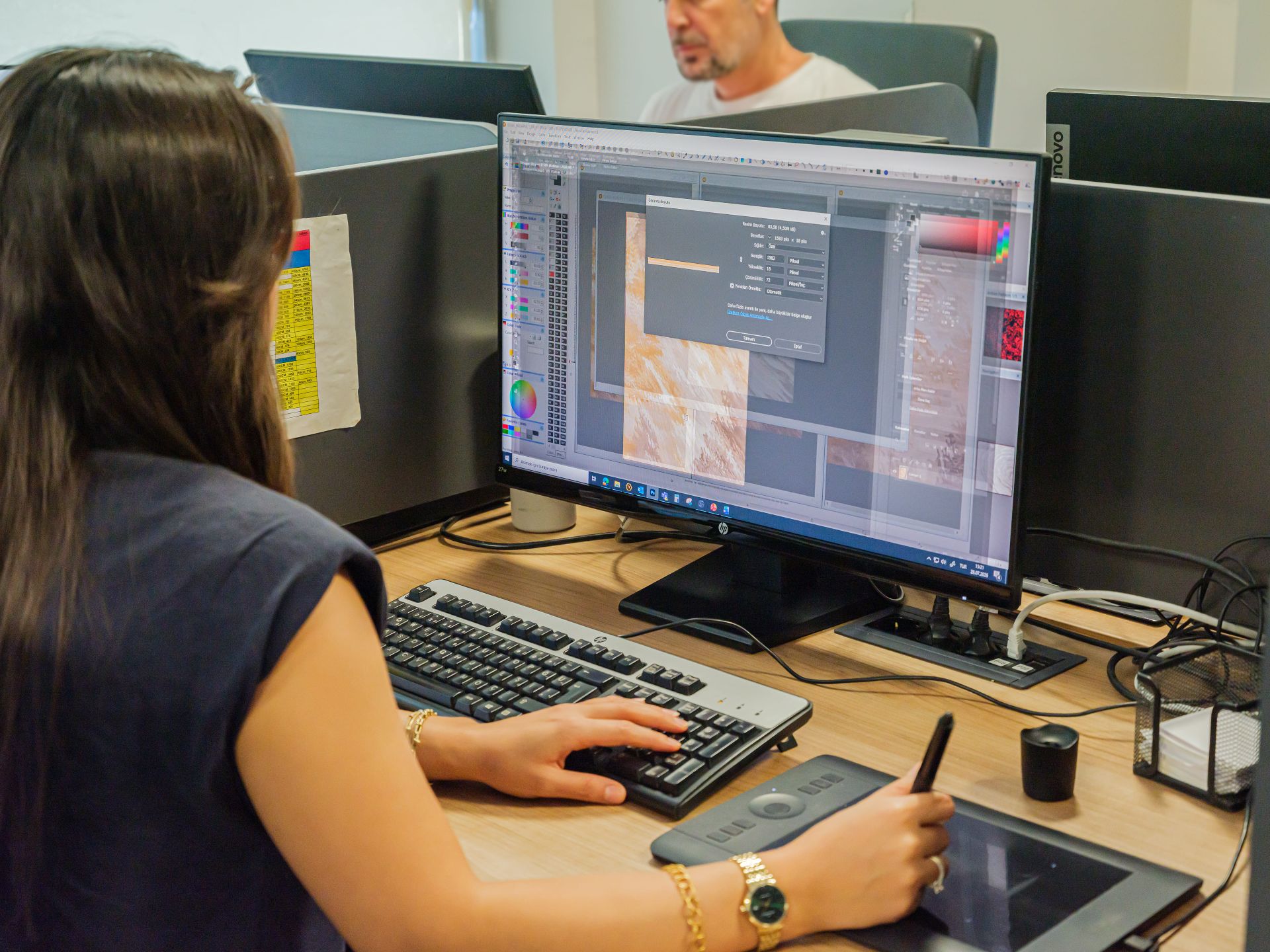
The company's collaboration with ZEKI at the Technical University of Berlin and its commencement of using AI-powered applications in design processes is therefore significant. The company defines artificial intelligence not as a replacement for human creativity, but as a tool that enhances it.
In Türkiye, the relationship between industry and artificial intelligence should now move beyond the "What is this technology used for?" stage. The real question should be "Where does it create efficiency in our production?"
There are no limits to the areas where artificial intelligence can touch industry. Design, quality control, maintenance, energy consumption, inventory management, demand forecasting, logistics, and customer relations are some of them. In the coming period, competitive advantage will not only come from cheap labor or large factories. Companies that use data better, operate their machines more intelligently, and understand customer needs faster will stand out.
Another requirement is sustainability. Carbon footprint, energy efficiency, water usage, waste management, recycling, and supply chain traceability are becoming increasingly important. Therefore, for Türkiye's exporting companies, green transformation is ceasing to be merely an environmental policy and is becoming a direct competitive advantage. Green investments, seen as a cost today, could be a ticket to global markets tomorrow. Türkiye's new industrial story will not be written solely by building larger factories. It will be written by companies that open up more to the world, produce higher added value, integrate artificial intelligence into production, and turn green transformation into a competitive advantage. The fact that a business story that started in Besni district of Adıyaman has now reached more than 100 countries shows that there is still an open window of opportunity for Türkiye. Let's see how many of our companies will be able to pass through that window.
"Türkiye is the only star in the region"
Referring to the strategic importance of Yumurtalık investment, İbrahim Erdemoğlu, Chairman of the Board of Erdemoğlu Holding, said, "Türkiye imports 23 billion dollars worth of petrochemical products annually. Now let's look at the global conjuncture more broadly. However you define America's long-term strategy, if there is a strategy to push China further into the Asian region in the medium and long term, then an alternative production base is needed in our geography for this to be implemented." When asked, "Where could this production base be?", he replied, "Looking at the global conjuncture, Russia is not an option. Europe's current structure is not suitable for this. The Balkans do not have sufficient scale. Three countries stand out: First, Türkiye. Second, Iran. Third, and to a more limited extent, Egypt. A new production base is needed in the region. According to our prediction, this country is Türkiye. This is our estimate. But in the picture we see, there is no strong alternative other than Türkiye. It will be surrounded by Syria, Iraq, Jordan, and Egypt. Türkiye will be the central country in the production and supply system of this geography. This idea is also at the heart of our main plan. The idea of the approximately 25 billion dollars investment in Yumurtalık also stems from this.”
Source: Milliyet
Industry Reaching Artificial Intelligence
Wednesday, 12 August 2026